


对于儋州市电工钢出口厂家35JN230产品,我们倾注了无尽的心血和热情。而我们的视频,正是我们向您展示这一成果的方式。
以下是:安徽芜湖儋州市电工钢出口厂家35JN230的图文介绍
电工钢硅钢片Electrical steel, also known as silicon steel sheet, is an indispensable metal material in the power, electronics, and military industries, and is also the largest functional material in production. It is mainly used as the iron core for various motors, generators, and transformers. Since it is a functional material, its performance testing also revolves around "function". These indicators are often mentioned in trade and processing processes, and a brief understanding can help everyone better carry out their work. The performance testing of electrical steel mainly includes the following aspects: magnetic inspection, stacking coefficient inspection, coating adhesion inspection, repeated bending inspection, size and shape surface inspection, and conventional mechanical property inspection. In addition to the types of products listed above, there are also some special purpose electrical steel plates, such as 0.15 and 0.20mm thick 3% Si cold-rolled non oriented silicon steel strips and 0.025, 0.05, and 0.1mm thick 3% Si cold-rolled oriented silicon steel strips, which are used as intermediate and intermediate grade High frequency motors and transformers, as well as pulse transformers, etc; 0.7mm thick 3% Si high-strength cold-rolled non oriented silicon steel plate for relays and power switches; High strength cold-rolled electrical steel plate for new high-speed motor rotors; Low carbon electrical steel hot-rolled thick and cold-rolled plates for magnetic shielding and high-energy accelerator electromagnets such as medical magnetic resonance tomography scanners; 4.5% to 6.5% Si high silicon steel plates for high-frequency motors, transformers, and magnetic shielding.
Generally, motors, transformers, and other electrical components are required to have high efficiency, low power consumption, small size, and light weight. Electrical steel plates are usually guaranteed to have magnetic properties based on core loss and magnetic induction strength. Magnetic induction strength is the number of magnetic lines passing through a unit cross-sectional area of the iron core, also known as magnetic flux density. It represents the material‘s magnetization ability, measured in T. The magnetic induction strength of electrical steel plates is high, and the excitation current (also known as no-load current) of the iron core is reduced. Copper and iron losses are also reduced, which can save electrical energy. When the power of the motor and transformer remains constant, the magnetic induction intensity is high, and the design Bm can be increased. The cross-sectional area of the iron core can be reduced, which reduces the volume and weight of the iron core, and saves the amount of electrical steel plates, wires, insulation materials, and structural materials used. This can reduce the total loss and manufacturing cost of the motor and transformer, and is beneficial for the manufacturing, installation, and transportation of large transformers and motors. The main requirements for the performance of silicon steel are:
1. Low iron loss is the most important indicator of the quality of silicon steel sheets. Various countries classify grades based on iron loss values, with the lower the iron loss, the higher the grade.
2. Under strong magnetic fields, the magnetic induction intensity (magnetic induction) is high, which reduces the volume and weight of the iron core of the motor and transformer, saving silicon steel sheets, copper wires, and insulation materials.
3. The surface is smooth, flat, and the thickness is uniform, which can improve the filling coefficient of the iron core.
4. Good lamination performance is more important for manufacturing micro and small electric motors.
5. The adhesion and weldability of the surface insulation film are good, which can prevent corrosion and improve the punching performan


电工钢硅钢片单取向电工钢指Goss取向,双取向特指立方取向电工钢。后者制备工艺极为复杂,目前难以工业化,所以取向硅钢广泛意义上指Goss取向。取向硅钢在易磁化的方向上具有高磁导率与低损耗特性,符合变压器等静态电力装备的导磁能力要求。单取向硅钢根据抑制剂和磁感的不同又可以分为CGO钢和Hi-B钢,具体如表1所示。其中,CGO钢的晶粒平均取向偏离角约为7°,饱和磁感值B8在1.82Tesla以上,主要用于中小型变压器的制造。Hi-B钢的晶粒平均取向偏离角约为3°,B8值在1.90Tesla以上,主要用于电力工业中的各种大型变压器、安徽芜湖同城扼流圈等高端电磁元件的制造。


鹿程国际贸易(芜湖市分公司)拥有雄厚的技术力量和多年来在 硅钢研制生产上积累的大量宝贵的实战经验,并不断致力于新 硅钢产品的开发研制以扩大生产规模,生产更多更好的 硅钢产品,回报新老客户的厚爱和所有的业界同仁的大力支持,携手共创美好的明天。
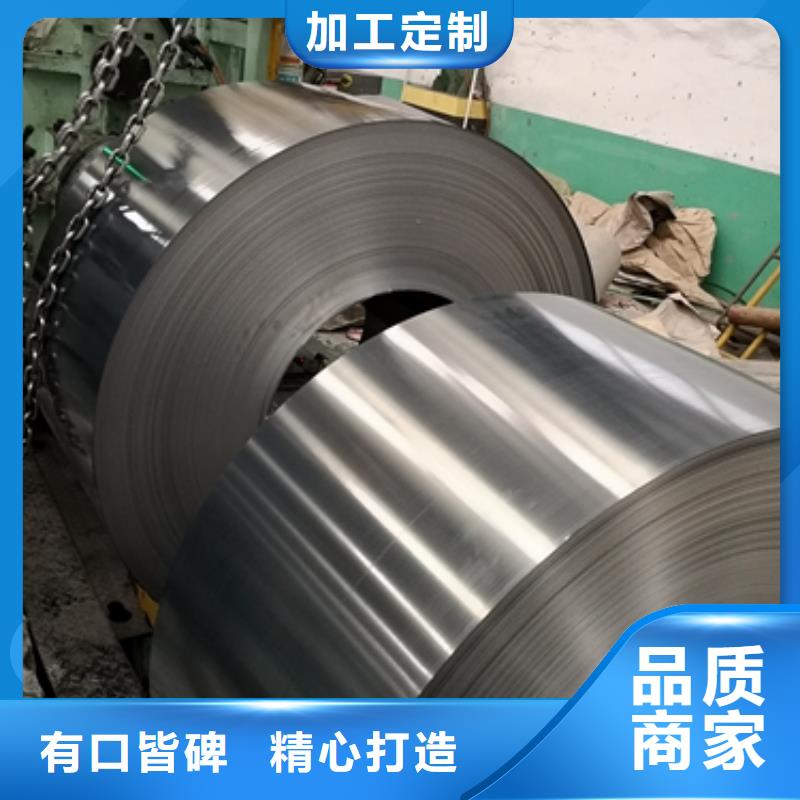

电工钢硅钢片:宝钢激光刻痕磁畴细化型产品磁性能检测采用了单片测试仪进行测试,通常情况下取向电工钢只测试平行于轧制方向的磁性能水平,特殊情况可以约定分别检测平行于轧制方向和垂直于轧制方向的磁性能。具体测试方法符合 GB/T 13789-2008(IEC 60404-3:2002,IDT)相关规定,测试试样公称尺寸为 500mm×500mm,测试试样长度的误差在±0.1%以内,测试试样的质量误差在±0.1%以内。为保证磁性测试结果对带钢磁性能的代表性,裁剪大单片试样时,试样中心位置与带钢宽度方向中心位置偏移量控制在≤50mm,试样边部距离样板边部控制在≥100mm,试样纵向与样板轧制方向的偏离角度≤1.0°,如附图 A.2 所示。试样要求剪切整齐、安徽芜湖当地平坦,直角性好,表面清洁,无影响性能试验的缺陷,试样边部不允许剪切后打磨,剪切毛刺高度不应高于 20μm。大单片试样不经过应力退火处理直接测试。


